
Water damage restoration
Storm and Flood Damage Restoration in the Hudson Valley and Capital Region
H&H Environmental handles storm and flood damage along with water damage restoration, and provides 24/7 emergency service. Floodwater is not the same as a plumbing leak, because it can carry sewage, bacteria and chemicals.
Call, and tell us where the property is so we can confirm we can get to you.
How H&H’s services apply after a storm or flood
Storm and flood damage is handled as part of H&H’s water damage restoration, with the same sequence of services.
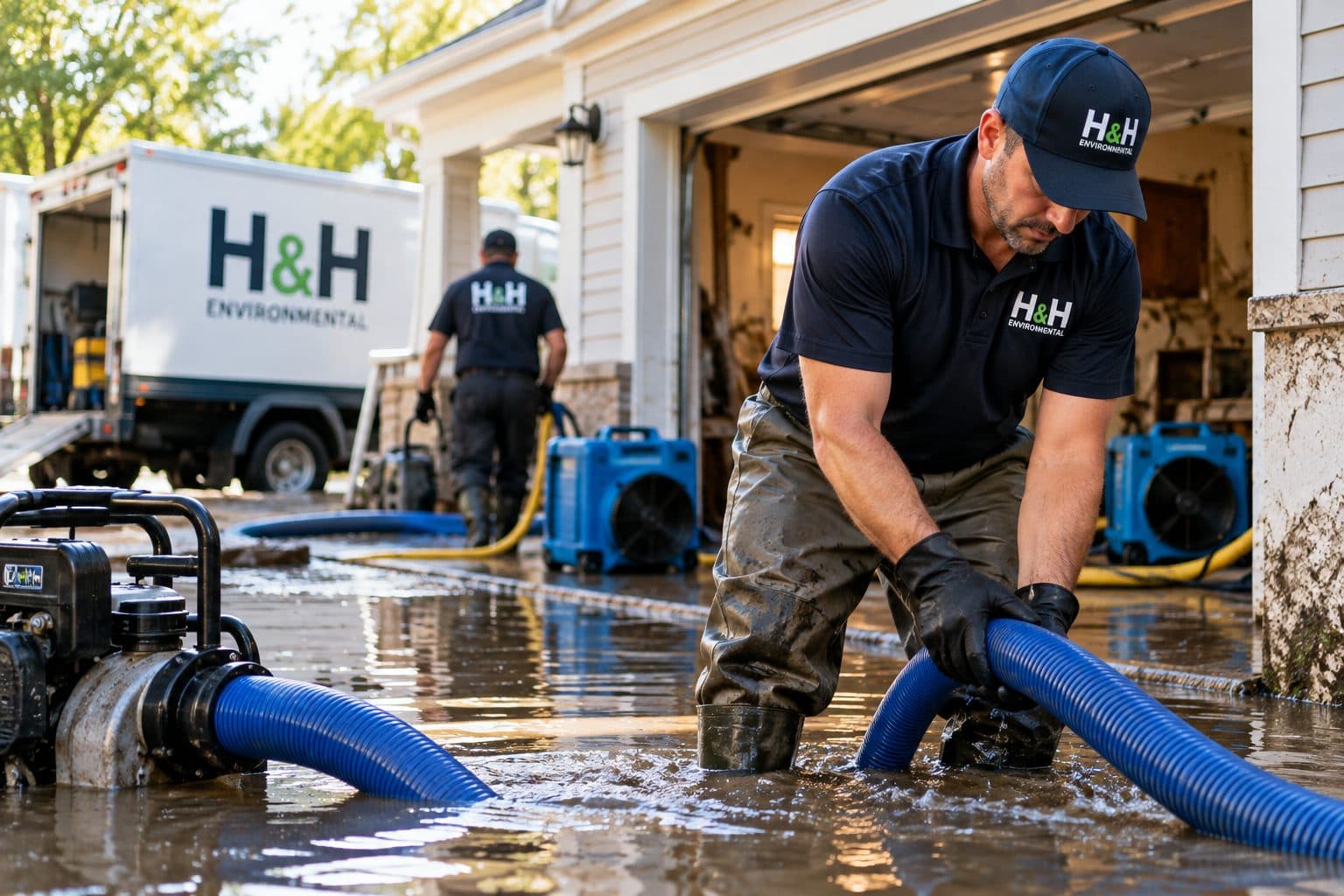
Water extraction
Removing standing water from the structure.
Removal of wet or damaged materials
Taking out materials that can’t be saved, where necessary.
Structural drying
Drying the building structure.
Antimicrobial treatment
Antimicrobial treatment of the affected area.
Monitoring
Tracking the drying process.
Why floodwater is different
Contamination
Floodwater can carry sewage, bacteria and chemicals into a home (EPA). If you do not know where the water came from, treat it as contaminated.
Structure
Check for structural damage before you enter (NYS Department of Health).
Gas and fuel
If you smell gas, do not use an open flame for light, because gas may be trapped inside (NYS DHSES). If fuel oil is floating on the water, it has to be cleaned up before the water is pumped out (NYS Department of Health).
Generators
If the power is out, never run a fuel-powered generator inside a home or garage. EPA says to keep generators outside and at least 20 feet from buildings (EPA).
Who should stay out
People with asthma or a weakened immune system should stay away from moldy sites and should not take part in flood cleanup, and children and pregnant people should not either (EPA).
What the federal record shows for the region
FEMA’s OpenFEMA data lists these counties in major disaster declarations with “flood” or “flooding” in the title. It is a record of past events, not a prediction for any property.
Ulster County
Thirteen declarations between 1971 and 2011 (OpenFEMA).
Dutchess County
Seven declarations between 1971 and 2023, the latest for storms that began July 9, 2023 (OpenFEMA).
Greene County
Eight declarations for incidents in 1987, 1996, 2000, 2003, 2004, 2005, 2006 and 2007, and the Hurricane Irene declaration for 2011 (OpenFEMA).
Saratoga County
Four declarations, in 1996, 1998, 2004 and 2019 (OpenFEMA).
Each county page goes further, with the local waterways, ice-jam and flash-flood records its own hazard plan documents. See all service areas.
Document the damage before cleanup
Photographs and video
EPA advises contacting your insurance company and taking pictures of your home and belongings before you start cleanup (EPA). The NYS Department of Health also recommends listing the damage and taking photos or video as you clean up (NYS Department of Health).
Items to discard
The NYS Department of Health suggests setting items you plan to discard outside to dry until the adjuster confirms your losses (NYS Department of Health). For more on how claims work, see insurance help.
Insurance
We work directly with your insurance carrier and provide documentation and direct billing for covered losses.
Whether a loss is covered depends on your policy and the cause of the damage. For more on how a claim works, see insurance help.
Frequently asked questions
Is floodwater different from water from a burst pipe?
Yes. Floodwater can carry sewage, bacteria and chemicals (EPA), so if you do not know where the water came from, treat it as contaminated.
Is it safe to go back in after a flood?
Not always. Do not enter a basement that flooded before the power was shut off (NYS Department of Health), and check for structural damage first. EPA notes that a professional may be able to help you decide whether it is safe to enter (EPA).
What should I photograph before cleanup?
Your home and belongings, before you start. EPA advises taking pictures before cleanup and contacting your insurance company (EPA).
Sources
The safety, health and local statements above come from these public sources. This article summarizes them in its own words, so follow the links for the full guidance. Each page was read on October 7, 2026.
U.S. Environmental Protection Agency
- Text Version of the Flooded Home
Re-entering a flooded home, the 24–48 hour drying window, photographs and insurance, humidity targets.
- Flood Cleanup to Protect Indoor Air and Your Health
Sorting materials, drying a flooded home, moisture meters, how long drying takes, when to get professional help.
New York State Department of Health
- Flood Cleanup and Home Repair
Standing water, protective gear, what to discard and what can usually be saved, documentation for insurance.
- Flooding: Quick Reference Guide
Do not enter a flooded basement if the electricity may be on; removing standing water; fuel oil; what to discard.
New York State Division of Homeland Security and Emergency Services
- Flood Safety Tips
Draining a flooded basement in stages after surrounding water subsides; electrical appliances; gas.
Federal Emergency Management Agency
- OpenFEMA Disaster Declarations Summaries: Ulster County, NY (data query)
Major disaster declarations that include Ulster County, New York.
- OpenFEMA Disaster Declarations Summaries: Dutchess County, NY (data query)
Major disaster declarations that include Dutchess County, New York.
- OpenFEMA Disaster Declarations Summaries: Greene County, NY (data query)
Major disaster declarations that include Greene County, New York.
- OpenFEMA Disaster Declarations Summaries: Saratoga County, NY (data query)
Major disaster declarations that include Saratoga County, New York.
Related help from H&H
H&H focuses on these counties: Ulster, Dutchess, Orange, Columbia, Albany, Saratoga, Fulton, Greene. Call and tell us where the property is, and we will confirm availability.