
Fire and smoke
Fire and Smoke Damage Services in the Hudson Valley and Capital Region
H&H Environmental provides fire and smoke services: smoke cleanup, water damage cleanup from fire losses, fire damage services, soot cleanup, contents cleaning, and contents storage. Call and tell us where the property is, and we will confirm availability.
Wait for the fire department to say the building is safe before you go in.
What H&H provides
These are the fire and smoke services H&H provides.
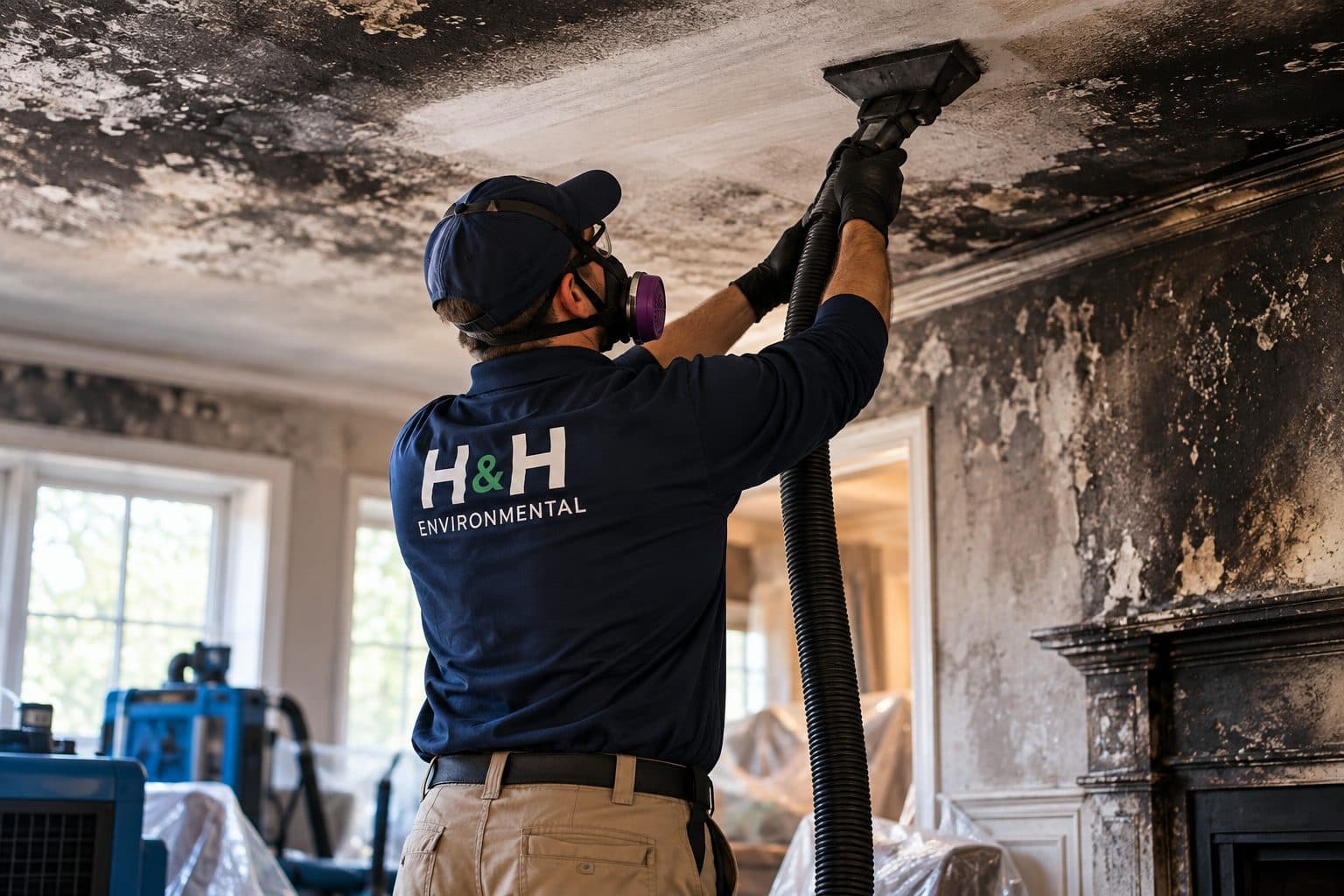
- Smoke cleanup
- Water damage cleanup from fire losses
- Fire damage services
- Soot cleanup
- Contents cleaning
- Contents storage
Call and tell us what happened and where the property is, and we will confirm availability.
First steps after a fire
This is government guidance for the first hours and days. It is not a description of H&H’s procedure.
Wait for the fire department
The U.S. Fire Administration says not to enter a damaged home or apartment unless the fire department says it is safe. The fire department makes sure the utilities are safe, and if they are not, firefighters have them turned off. Do not try to turn them back on yourself (U.S. Fire Administration).
Floors and walls
Floors and walls may not be as safe as they look (U.S. Fire Administration). FEMA advises checking for structural damage before re-entering, and never trying to salvage belongings at the expense of your own safety (FEMA).
Call your insurance company
The U.S. Fire Administration advises contacting your insurance company right away and asking what to do first, including who to talk to about cleaning up your home (U.S. Fire Administration).
Record the damage
FEMA advises taking photographs of damaged items for insurance purposes (FEMA). The U.S. Fire Administration advises saving all receipts for money you spend, because the insurance company may need them (U.S. Fire Administration).
What a fire leaves behind
Smoke and soot
The soot and dirty water left behind may contain things that could make you sick, so be very careful if you go into your home or touch fire-damaged items (U.S. Fire Administration). The NYS Department of Health says all smoke is hazardous to breathe, and that people can have symptoms from smoke, heat, fire and odors even when visible smoke is not present (NYS Department of Health).
Particles and building materials
FEMA lists particulates, exposed asbestos, lead-containing building materials such as glass and lead paint, and chemical residues among the risks in fire-damaged areas (FEMA).
Protective clothing
FEMA advises disposable nitrile or latex gloves, safety goggles, a long-sleeved shirt, long pants, sturdy shoes or boots, and an N95 mask or face covering (FEMA).
Health symptoms
The NYS Department of Health advises people who think they may be having symptoms from smoke exposure to contact their primary health care provider (NYS Department of Health).
This page is general information. It is not medical advice, and no cleanup service can promise a health outcome.
Water from putting out the fire
Things the fire did not touch
Things not damaged by the fire may still be ruined by smoke and may be soggy with the water used to put out the fire, and anything you want to save will need to be carefully cleaned (U.S. Fire Administration).
Holes cut by firefighters
To fight the fire, firefighters may have broken windows, cut holes in the roof and cut holes in the walls to make sure the fire is out (U.S. Fire Administration).
Mold
If water was used to put out the fire, FEMA says mold may also be an issue and should not be inhaled (FEMA). Water from a fire loss is part of H&H’s fire and smoke services, and the drying work is covered under water damage restoration and structural drying.
Soot and your belongings
FEMA wrote this guidance for cherished heirlooms, with professional conservators. It is not H&H’s procedure for contents cleaning.
Handle less
FEMA says to reduce how much you handle or touch damaged items, because soot’s very fine particles stick to everything and every touch grinds it further in. Soot and ash are also abrasive and can scratch (FEMA).
Time matters
The longer soot stays on an item, the harder it is to remove (FEMA).
No water at first
FEMA says not to use water or any other cleaning solution on soot-covered heirlooms, because water drives soot and ash further into the surface. It advises vacuuming the soot and ash off as soon as possible, preferably with a HEPA filter on the lowest setting, never vacuuming wet or damp items (FEMA).
Precious items
If a precious item is badly damaged, FEMA says a conservator may be able to help (FEMA). Contents cleaning and contents storage are among H&H’s fire and smoke services.
Do you need air or soot testing?
What the Department of Health says
The NYS Department of Health says environmental testing is rarely needed to direct cleanup efforts or to decide whether a building may be reoccupied. When testing is necessary, it is usually done for specific fire-related chemicals under a comprehensive sampling plan, with samples analyzed by a laboratory certified through the state’s Environmental Laboratory Approval Program (NYS Department of Health).
Indoor air quality
H&H’s indoor air quality services are a separate set of services. Call and tell us what you are concerned about.
Fire and smoke guides
General information from government sources, explained plainly. It does not replace calling us about your property.
Fire loss and your insurance
We work directly with your insurance carrier and provide documentation and direct billing for covered losses.
Whether a loss is covered depends on your policy and the cause of the damage. The U.S. Fire Administration notes that companies specialize in cleaning and restoring belongings, advises asking your insurance company for recommendations, knowing whether you or your insurance company will pay for the cleaning, and asking for a cost estimate in writing (U.S. Fire Administration). For more on how a claim works, see insurance help.
Frequently asked questions
What fire and smoke services does H&H provide?
Smoke cleanup, water damage cleanup from fire losses, fire damage services, soot cleanup, contents cleaning, and contents storage. Call and tell us what happened.
When can I go back into my home after a fire?
Not until the fire department says it is safe (U.S. Fire Administration). Even then, FEMA advises checking for structural damage and never trying to salvage belongings at the expense of your own safety (FEMA).
Can I wash soot off my belongings?
FEMA’s advice for cherished items is not to use water or any cleaning solution on soot, because water can drive it further into the surface, and to vacuum it off first (FEMA). For what to do with your belongings, call and tell us what was affected.
Do I need soot or air testing after a fire?
The NYS Department of Health says environmental testing is rarely needed to direct cleanup or to decide whether a building may be reoccupied, and that when it is needed it is done for specific chemicals under a sampling plan (NYS Department of Health).
Who should I call first after a fire?
The fire department decides when it is safe to enter. The U.S. Fire Administration advises contacting your insurance company right away and asking what to do first (U.S. Fire Administration). Then call us and tell us what happened.
Sources
The safety, health and local statements above come from these public sources. This article summarizes them in its own words, so follow the links for the full guidance. Each page was read on October 22, 2026.
U.S. Fire Administration, FEMA
- After the Fire (FA-46, January 2019)
When it is safe to go back in; utilities; calling the insurance company first; companies that clean and restore belongings; receipts.
FEMA and the Heritage Emergency National Task Force
- After the Fire: Advice for Salvaging Damaged Family Treasures
Hazards in fire-damaged areas; protective clothing; handling and cleaning soot-covered items; photographs for insurance; conservators.
New York State Department of Health
- What You Should Know about Fires
Smoke is hazardous to breathe; symptoms; when environmental testing is and is not needed after a fire; contacting a health care provider.
Related help from H&H
H&H focuses on these counties: Ulster, Dutchess, Orange, Columbia, Albany, Saratoga, Fulton, Greene. Call and tell us where the property is, and we will confirm availability.